Do exercises for snoring work?
Structured mouth, tongue and throat exercise programmes may reduce snoring for some adults, but results vary. Small trials have found improvements after regular practice over eight weeks or three months. No exercise is proven to stop everyone’s snoring, and those findings do not validate Night & Air’s exact routine. See the studies and their limits.
This illustrated guide shows the 11 movements in Airway Foundation: seven mouth and facial movements, plus four breathing and comfort steps. It explains how guided practice works and how to review your own experience without expecting an overnight result.
The app provides the sequence, movement demonstration, timing and repetition cues. You can concentrate on a comfortable movement instead of remembering an exercise list or counting everything yourself.
See how the app guides the movement
The screen keeps the current movement, progress and controls together. These are actual app visuals, not before-and-after outcome evidence.
Read the video description
The recording shows the Night & Air Tongue Curlers screen. An animated illustration demonstrates the movement while the interface displays the current cue and repetition progress. It demonstrates guided delivery, not a measured effect on snoring.
Before you practise
Use gentle movements while awake. The descriptions below introduce the current app instructions; follow its moving demonstration for setup, timing and repetitions. You do not have to complete every movement when it is uncomfortable or unsuitable.
- Never force nasal breathing through blockage. Skip a nasal-breathing step if airflow feels difficult.
- Stop for pain, jaw or throat strain, dizziness, chest discomfort or unusual breathing distress.
- Do not force breath holds, add extra resistance or push for a larger movement to meet a timer.
- If you have jaw or swallowing problems, recent mouth or throat surgery, or uncertainty about the technique, seek suitable professional advice before self-directed practice.
Mouth taping is not part of these exercises. Dry mouth or mouth breathing alone does not identify a cause of snoring.
Movement library · 7 exercises
Mouth, tongue and throat exercises: seven guided movements
Oropharyngeal and myofunctional programmes involve coordinated movements around the mouth and throat. These seven app movements cover tongue, cheek, palate and lip actions. Research evaluates combined programmes; it does not establish an independent snoring benefit for every movement below.
Find a movement: Tongue Curlers · Tongue Push-ups · Soft Palate Raise · Open Mouth “Aah”. Lip and cheek movements are also included below.
Open any card for the full illustration and instructions. The cards are grouped by type; their numbers match the app’s 11-step session. Follow the order shown in the app.
05
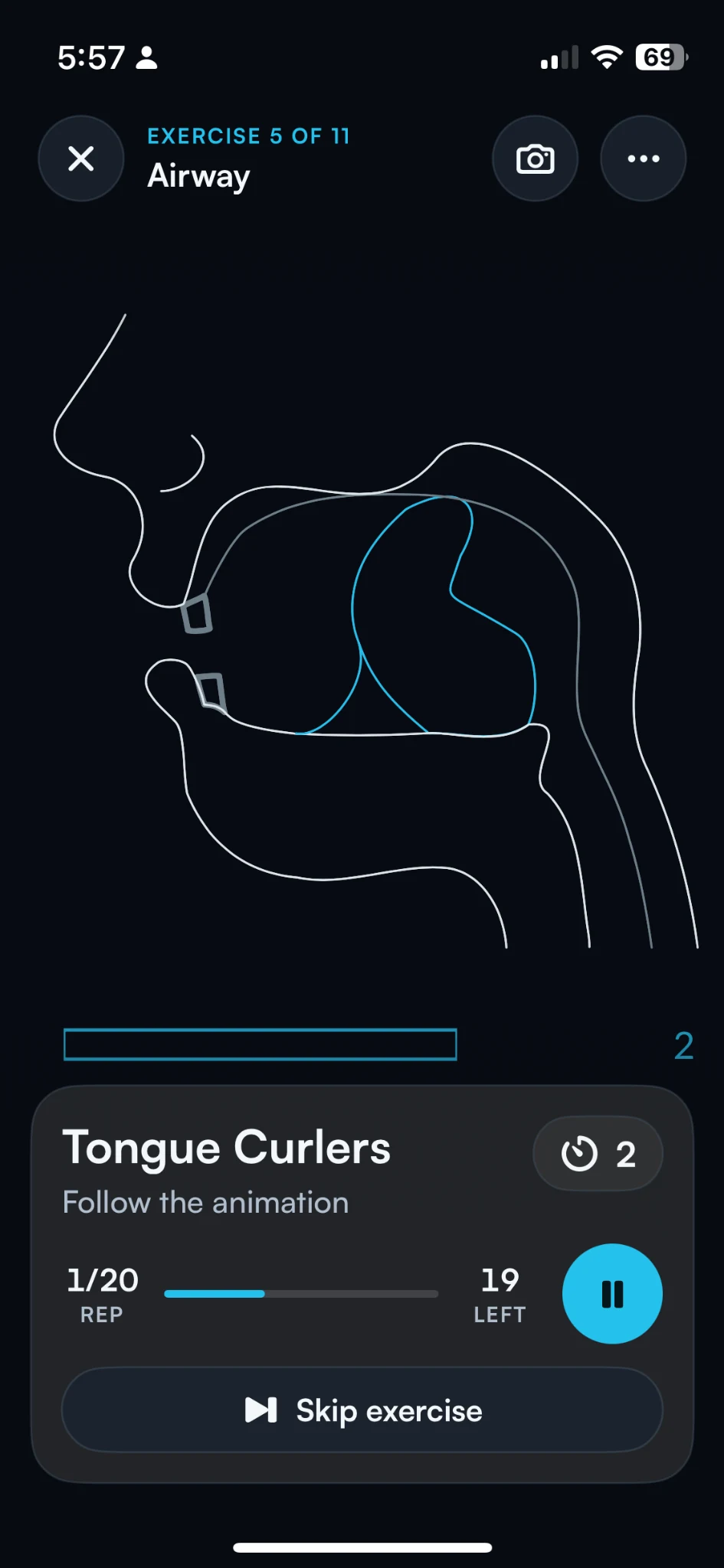
Tongue Curlers
A small upward-and-back movement of the tongue tip, followed by a relaxed return.
View illustration and instructions
Follow the movement
- Keep your jaw loose and let your tongue relax.
- Curl the tongue tip upward and slightly back in a small controlled movement.
- Return smoothly to a relaxed position.
Comfort cue: Do not clench the jaw or strain it. Curl gently; do not push hard.
Use the current in-app timing and repetitions. This illustration is not a prescription to complete a fixed number.
06
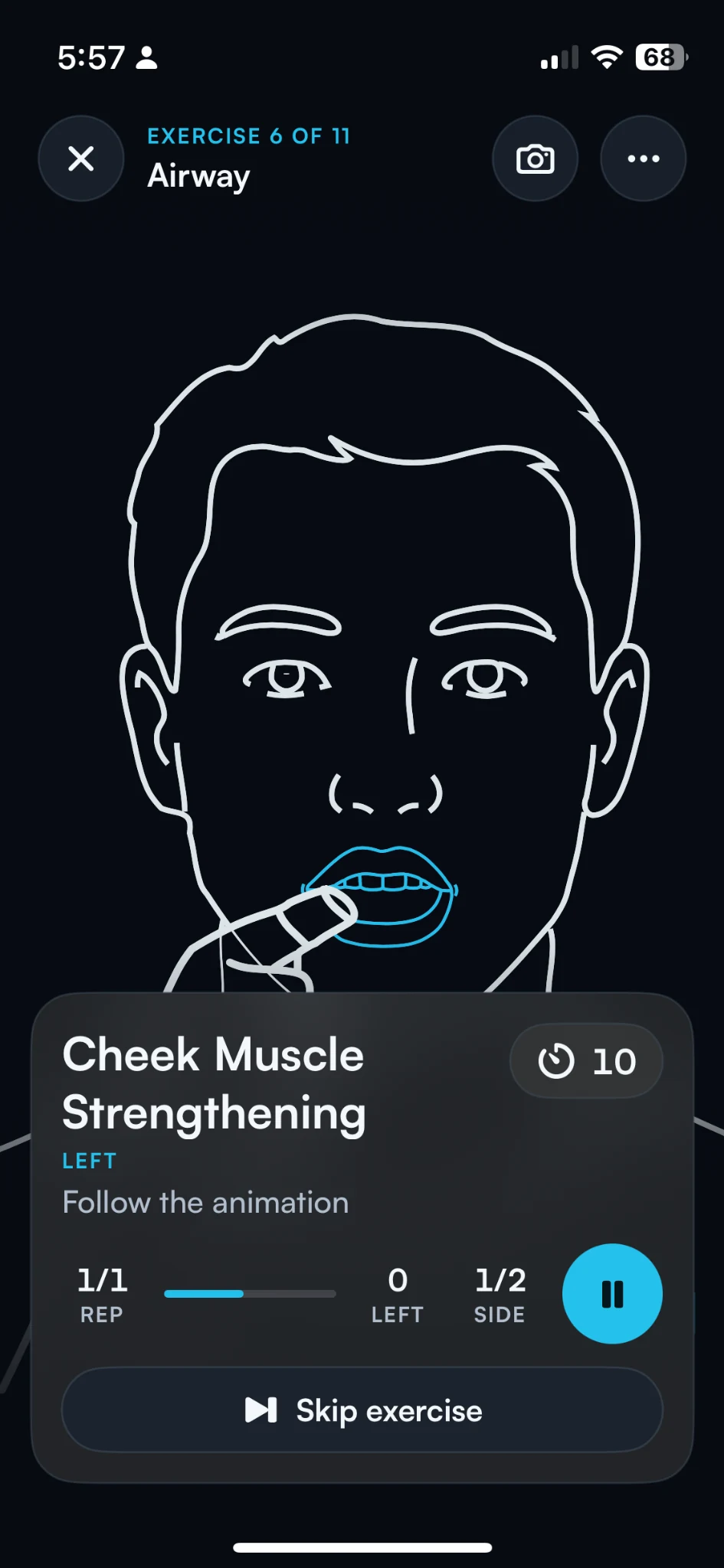
Cheek Muscle Strengthening
Gentle cheek resistance while the jaw stays still.
View illustration and instructions
Follow the movement
- Follow the app's finger position against the cheek.
- Press the cheek gently outward against light resistance while keeping the jaw still.
- Relax, and complete the shown left-side sequence before the right.
Comfort cue: Use light resistance rather than force. Keep the jaw from clenching or moving to produce the pressure.
Use the demonstrated finger placement. If it is unclear, skip the movement and ask for guidance rather than guessing.
Use the current in-app timing and repetitions. This illustration is not a prescription to complete a fixed number.
07
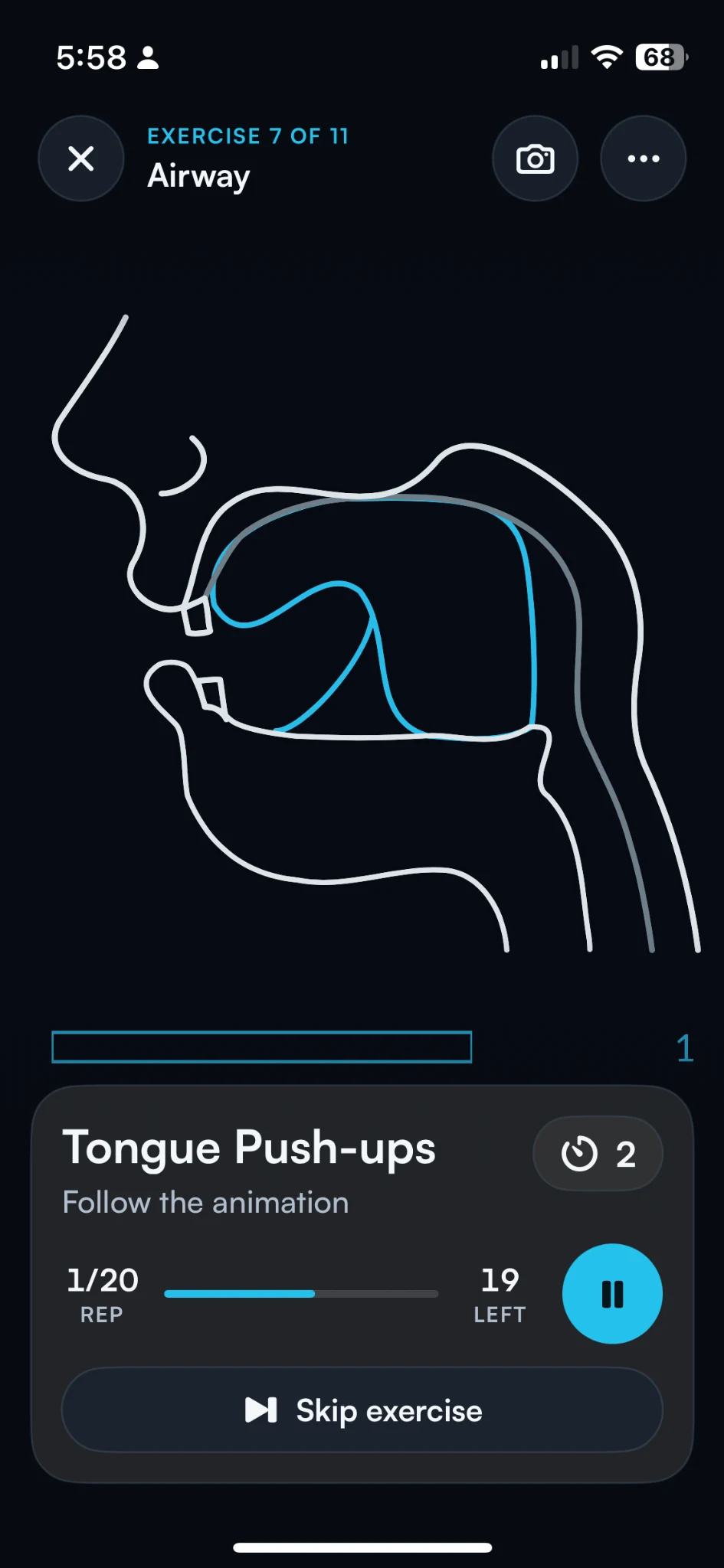
Tongue Push-ups
An upward tongue press toward the roof of the mouth, with a full release.
View illustration and instructions
Follow the movement
- Keep your jaw still.
- Press the tongue gently upward toward the roof of the mouth.
- Release fully before the next repetition.
Comfort cue: Do not bite down or lift the chin.
Use the current in-app timing and repetitions. This illustration is not a prescription to complete a fixed number.
08
Soft Palate Raise
A gentle internal lift using the cue of a quiet “ah” or a small yawn.
View illustration and instructions
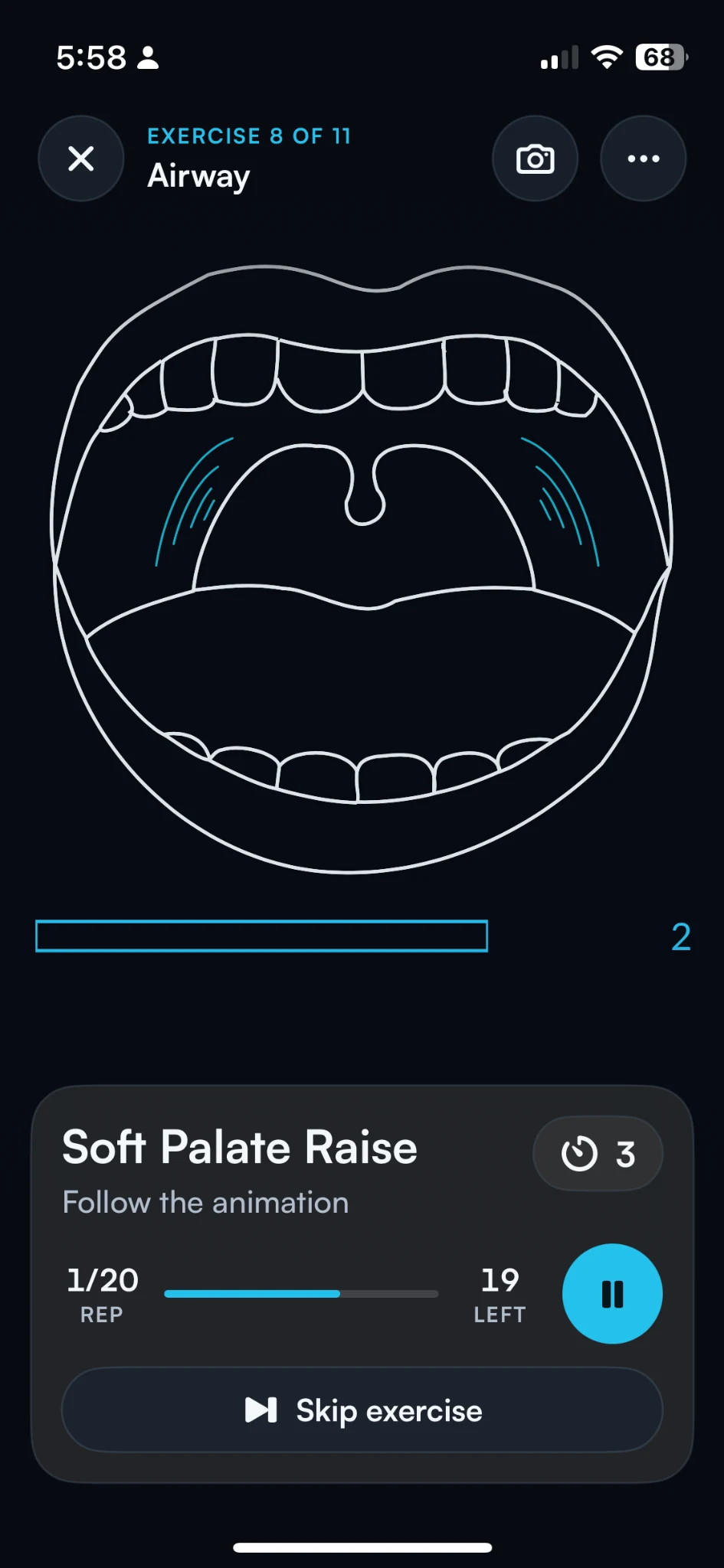
Follow the movement
- Follow the app's gentle lift, as if beginning a quiet 'ah' or a small yawn.
- Keep the throat comfortable.
- Let the throat return to neutral and relax.
Comfort cue: Do not force a yawn or strain the throat.
Use the current in-app timing and repetitions. This illustration is not a prescription to complete a fixed number.
09
Lip Resistance
A controlled lip seal against the resistance demonstrated in the app.
View illustration and instructions
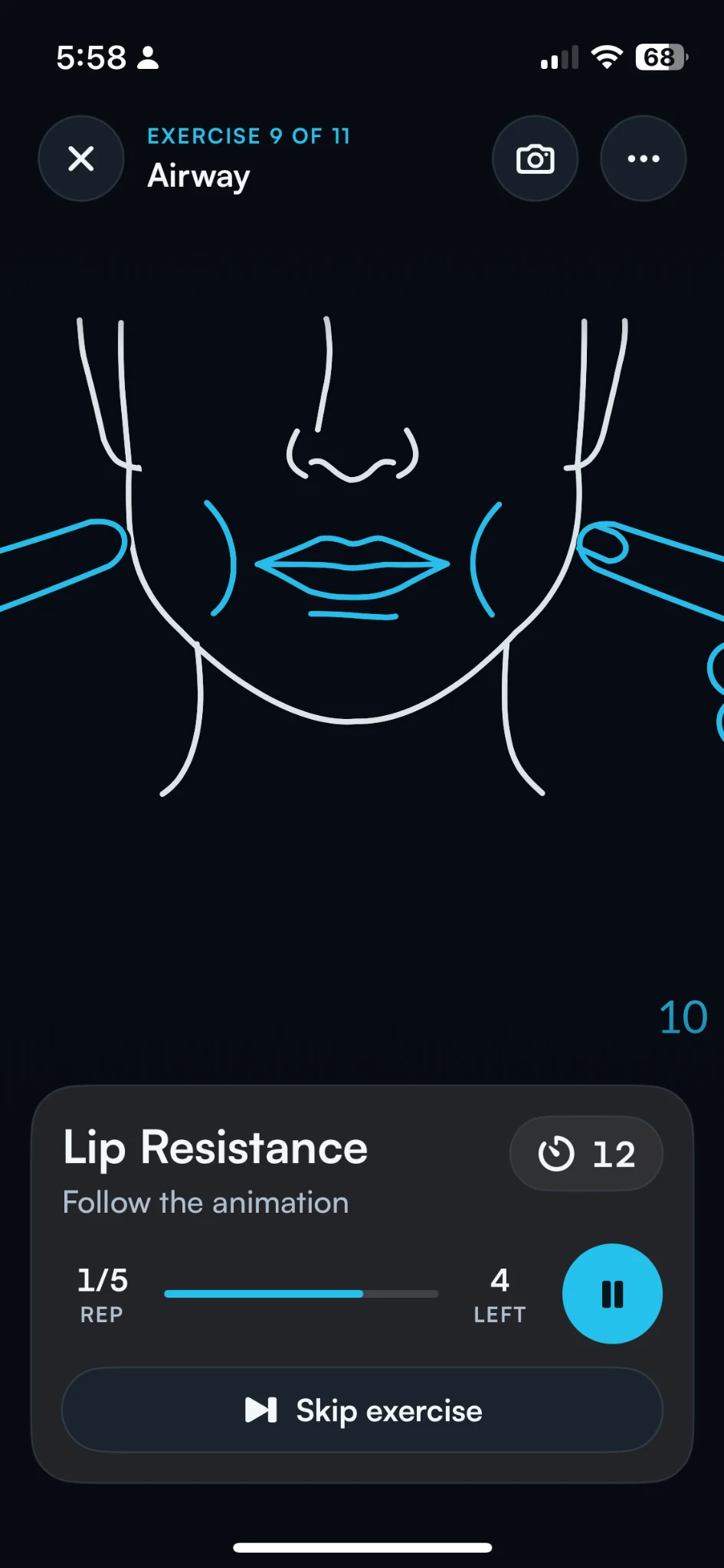
Follow the movement
- Follow the resistance setup shown in the app.
- Close the lips gently against that resistance.
- Keep the jaw soft and release fully.
Comfort cue: Use only enough resistance to feel the lips working. Do not clench the teeth.
Use only the demonstrated setup. Do not add an improvised object, weight or mouth tape.
Use the current in-app timing and repetitions. This illustration is not a prescription to complete a fixed number.
10
Open Mouth “Aah”
A comfortable mouth opening and a quiet “aah,” followed by relaxation.
View illustration and instructions
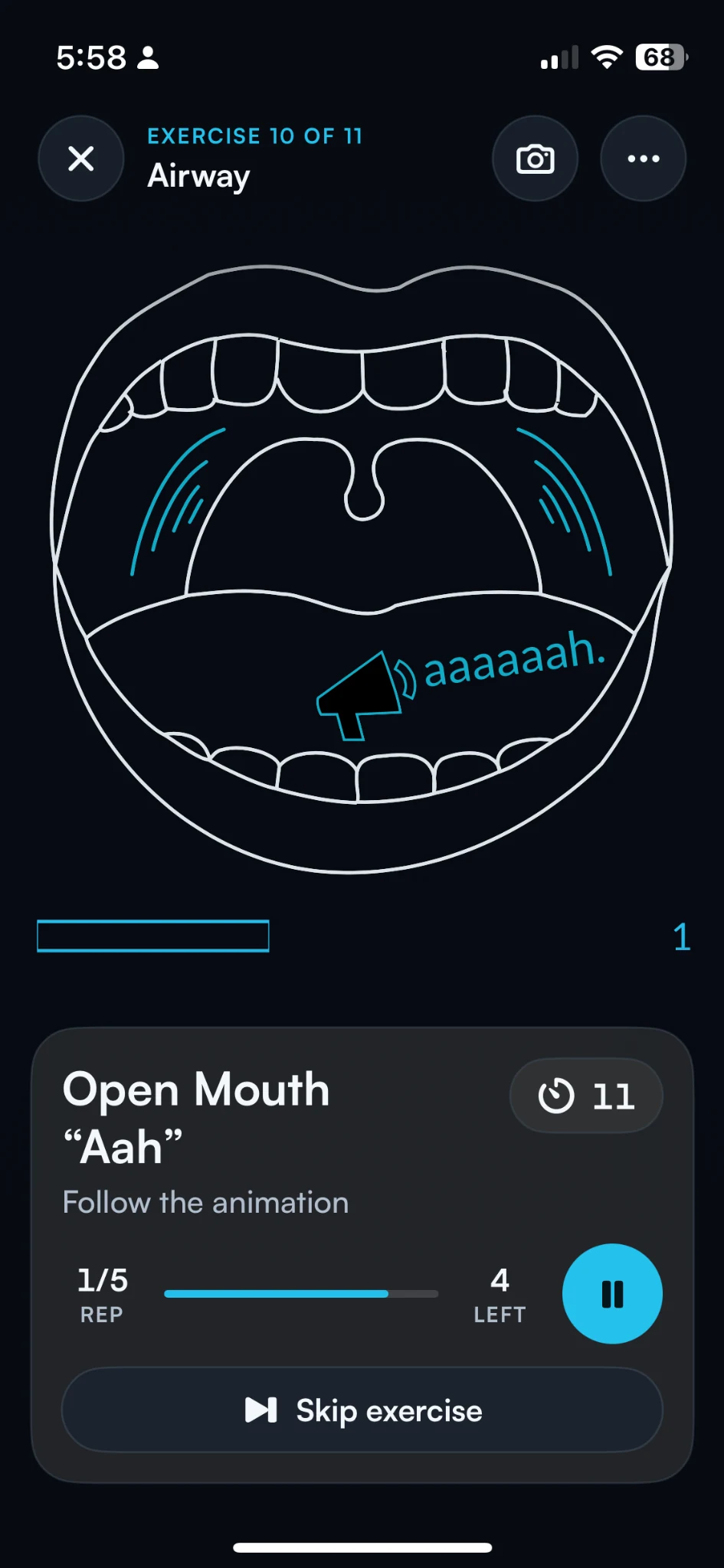
Follow the movement
- Open your mouth only as far as comfortable.
- Form a gentle, quiet 'aah'.
- Close and relax.
Comfort cue: Do not push the voice's volume or range. Avoid throat strain.
Use the current in-app timing and repetitions. This illustration is not a prescription to complete a fixed number.
11
Half Smiles
One controlled mouth-corner movement at a time, with the head and jaw centered.
View illustration and instructions
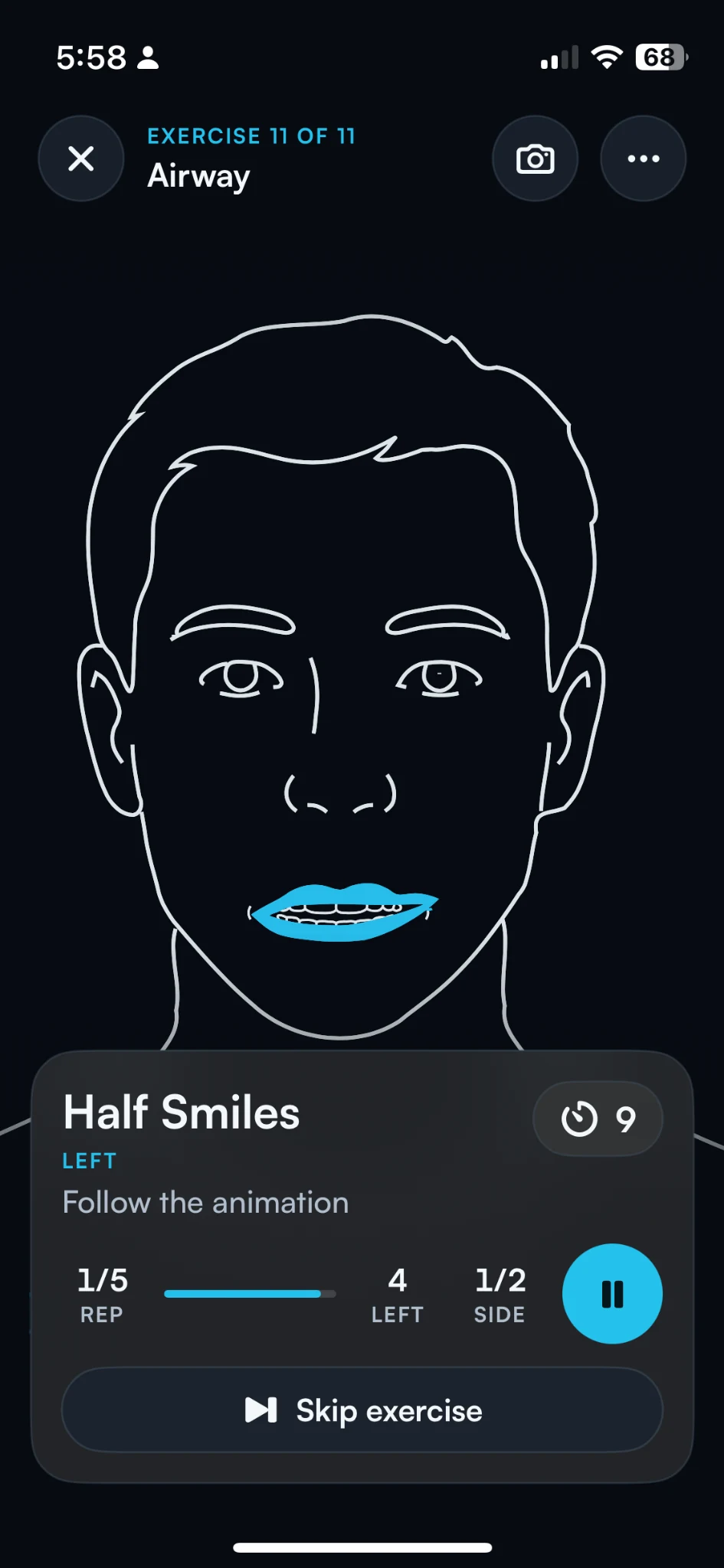
Follow the movement
- Draw the shown corner of the mouth into a controlled half smile.
- Hold gently while keeping your jaw and head centered.
- Return to center; finish the shown left-side sequence before the right.
Comfort cue: Keep the hold gentle; do not twist the jaw or head.
Use the current in-app timing and repetitions. This illustration is not a prescription to complete a fixed number.
Comfort library · 4 steps
Breathing and comfort steps
These steps guide comfortable breathing, pacing or gentle facial touch. The snoring studies below do not establish each of these four steps as a snoring treatment. They must not be used to force nasal airflow or delay assessment of breathing symptoms.
01
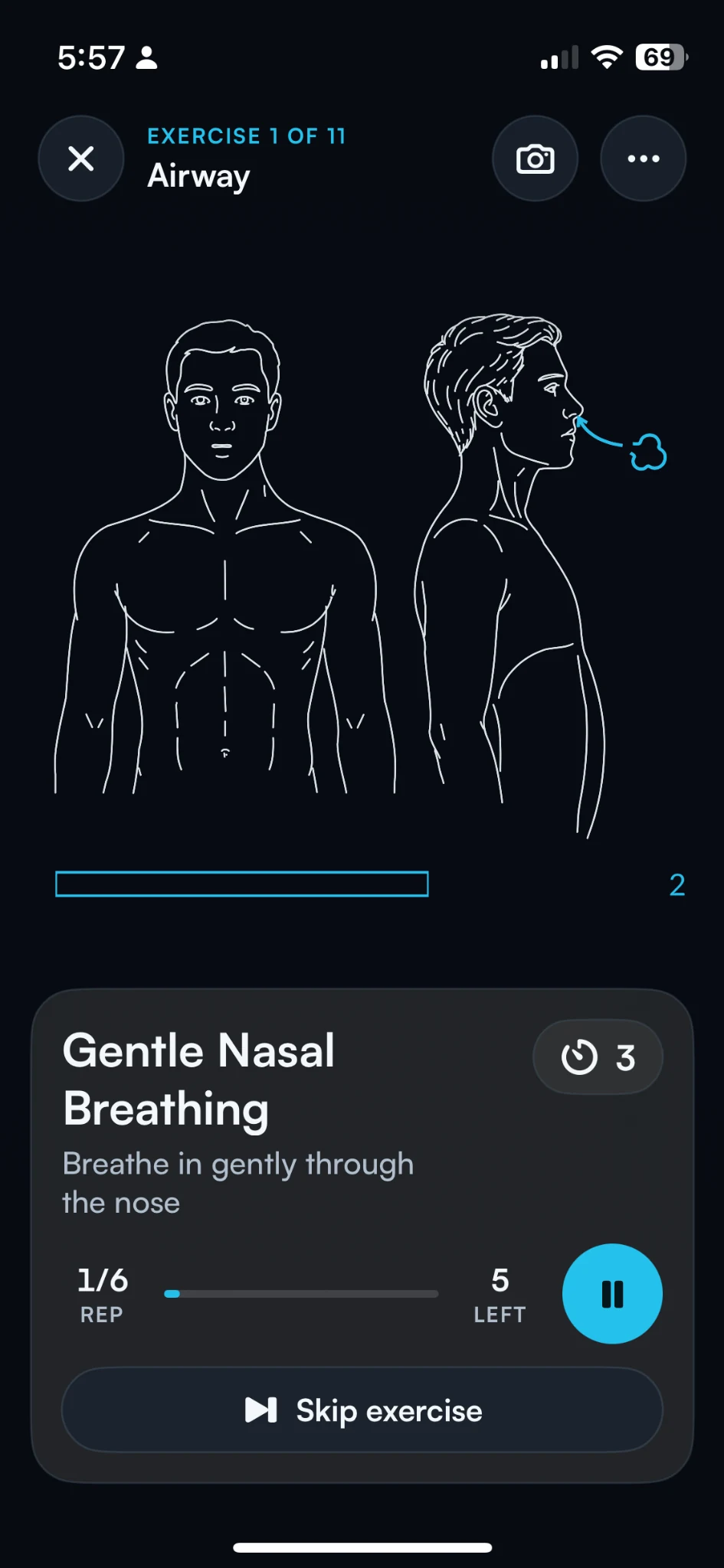
Gentle Nasal Breathing
Quiet breathing with a softer, slightly longer exhale, only while nasal airflow is comfortable.
View illustration and instructions
Follow the movement
- Breathe quietly through your nose only while airflow feels comfortable.
- Let the exhale become slightly longer and softer.
- Return to a relaxed breath.
Comfort cue: Skip this step if your nose is blocked or breathing through it feels difficult. Do not force airflow or make the breath larger to meet a timer.
Use the current in-app timing and repetitions. This illustration is not a prescription to complete a fixed number.
02
Sinus Massage
Very light circular pressure at the soft-tissue location shown in the app.
View illustration and instructions
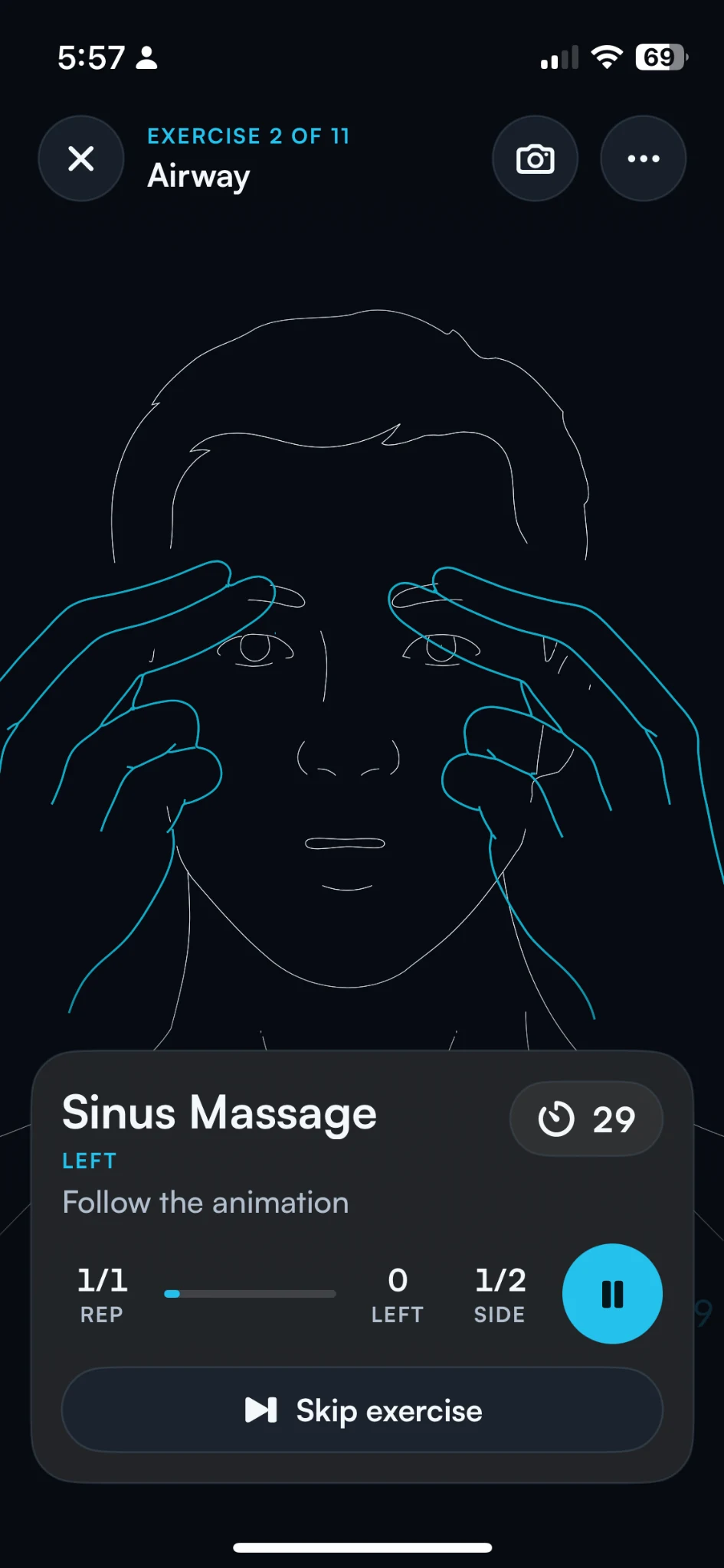
Follow the movement
- Follow the location shown in the app animation.
- Use very light circular pressure on the shown soft tissue, breathing normally.
- Follow the app's side or location change, then relax.
Comfort cue: Do not press hard on the eye or on painful areas.
Use the moving demonstration to identify the location. A still image is not a complete placement guide; do not improvise pressure around the eye.
Use the current in-app timing and repetitions. This illustration is not a prescription to complete a fixed number.
03
Box Breathing
A paced sequence of inhale, pause, exhale and pause.
View illustration and instructions
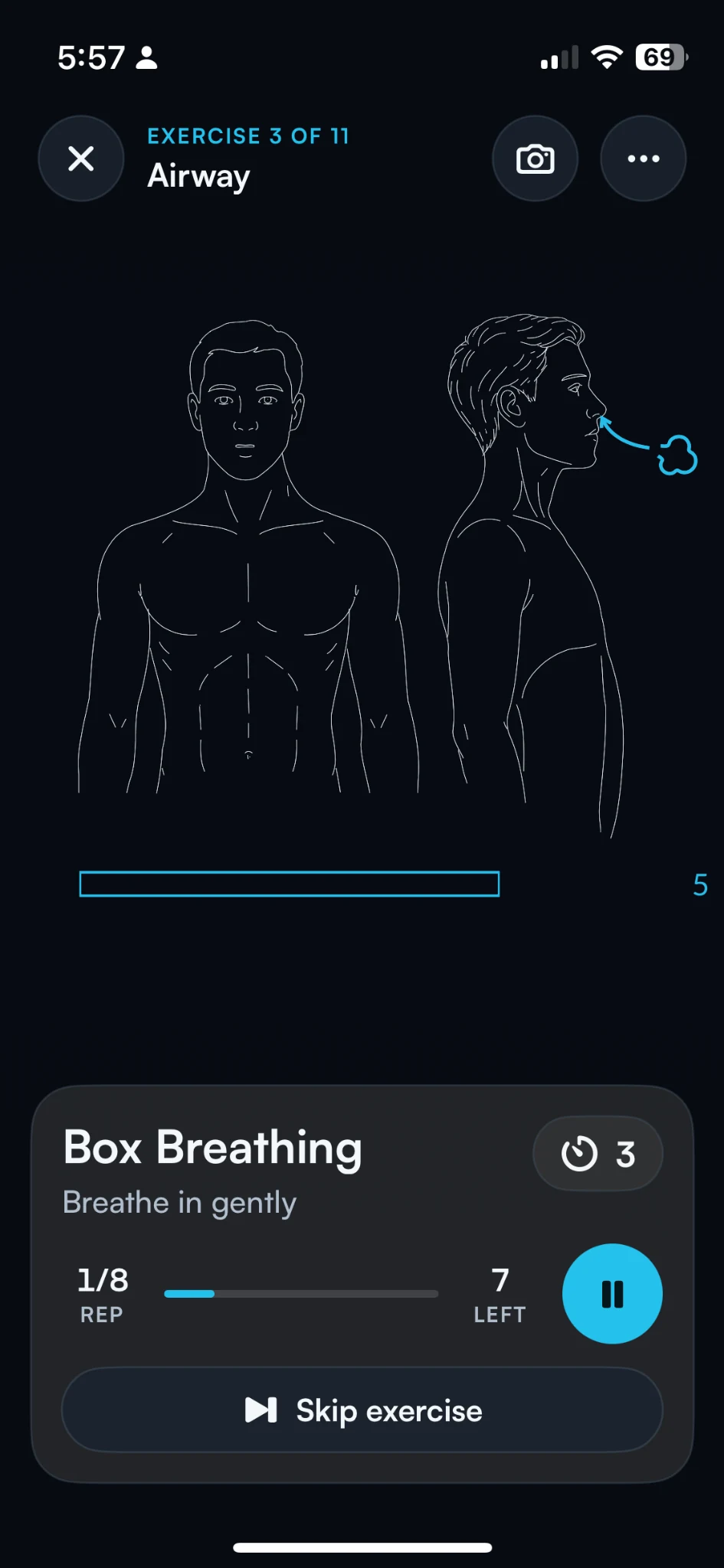
Follow the movement
- Inhale gently.
- Pause while staying relaxed.
- Exhale slowly.
- Pause again, keeping the shoulders soft; then repeat only while comfortable.
Comfort cue: Keep the breath comfortable rather than forcing a large inhale. Stop if dizzy or uncomfortable. Do not force the breath-hold phases.
Let comfort take priority over completing a pause. Skip the step if breath holds feel difficult.
Use the current in-app timing and repetitions. This illustration is not a prescription to complete a fixed number.
04
Alternate Nostril Breaths
A guided left-inhale, right-exhale, right-inhale, left-exhale sequence.
View illustration and instructions
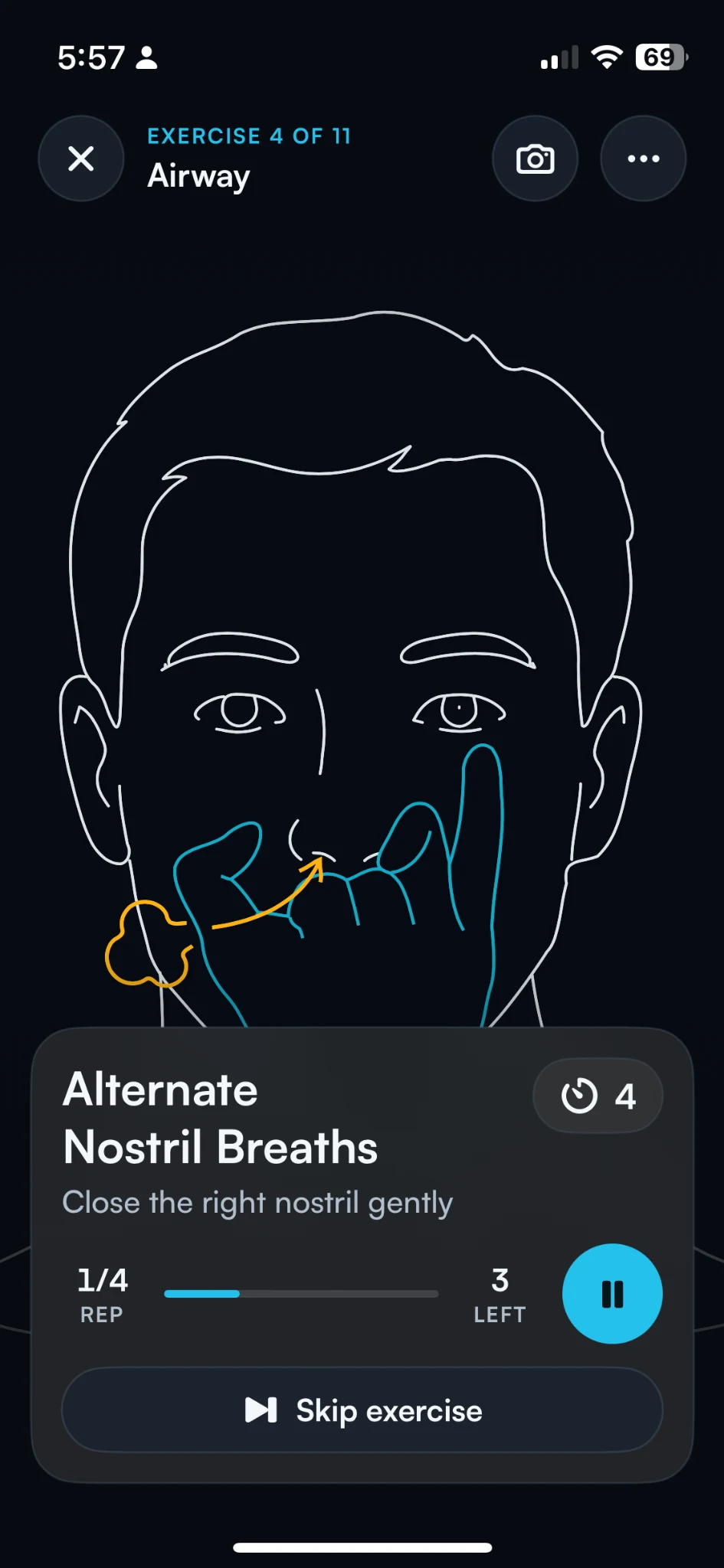
Follow the movement
- Gently close the right nostril and inhale through the left.
- Switch sides smoothly and exhale through the right.
- Inhale quietly through the right.
- Switch back and exhale softly through the left.
Comfort cue: Skip when nasal airflow is uncomfortable or substantially blocked. Do not force air through a blocked nostril.
There are four phases in a cycle. Do not add breath holds or force air through a blocked nostril.
Use the current in-app timing and repetitions. This illustration is not a prescription to complete a fixed number.
What is myofunctional therapy for snoring?
Myofunctional therapy uses a structured programme of mouth, tongue and throat movements. Research often calls these oropharyngeal exercises; they are also described more simply as throat exercises for snoring. The studies below tested specific combined programmes, not a single universal movement or routine.
Airway Foundation provides guided wellness practice. It is not a diagnosis, an individualized therapy prescription or a replacement for clinician-directed care. Breathing and relaxation steps should not be assumed to have the same evidence as the studied programmes.
What does research say about snoring exercises?
Randomized trial · 2015 · CHEST
39 adults, three months
Ieto and colleagues studied a combined oropharyngeal programme in adults with primary snoring or mild-to-moderate sleep apnea. The authors reported a 36% reduction in snoring frequency and 59% in total snoring power. These are study outcomes for the combined programme, not the percentage of people cured or effects attributable to a single exercise.
Randomized trial · Published online 2018
16 people analyzed, eight weeks
Goswami and colleagues evaluated a smartphone-delivered exercise programme. In the analyzed participants, the rate of recorded snores above 60 dB fell by 22% in the exercise group and 5.6% in the control group at eight weeks. The sample was small, the programme and measurements were specific, and the app studied was not Night & Air.
Cochrane review · 2020
The wider evidence remains uncertain
In people with obstructive sleep apnea, the review judged evidence for snoring-frequency reduction versus sham therapy very low certainty; subjective snoring intensity probably improved slightly. That is a reason to keep expectations measured and continue prescribed care.
What this means for Night & Air: these studies support investigating structured exercise programmes. They do not clinically validate this app, its exact 11-movement library or its Snore Score. The seven mouth-and-facial movements and four comfort steps are not 11 independently proven remedies.
How long do snoring exercises take to work?
There is no guaranteed response time. Research programmes last weeks to months, and some people may not notice a clear change. A quiet night after one session cannot establish an exercise effect.
Airway Foundation is ongoing daily practice with a check-in every four weeks. The 28-day check-in is a chance to review the pattern and your experience, not a completion date or a promise that snoring will improve by then. The trials above assessed their programmes over eight weeks or three months.
- Follow the current guided session. The animation, phase timer and repetition cues keep the next movement visible.
- Pause or skip when needed. Comfort takes priority over finishing a counter. Do not add an extra routine from several websites.
- Keep recording and checking in. Use a steady phone setup and record completion and unusual nights honestly.
- Review at the planned check-in. Consider the recorded pattern, comfort and whether the practice is realistic to continue.
The purpose is less planning and remembering for you. A personal comparison still cannot prove which movement caused a change.
How Foundation differs from a five- or seven-night tune-up
Night & Air first builds a baseline from seven qualifying, reviewed ordinary nights. A habit tune-up then compares one manageable change over its planned five or seven qualifying nights. Foundation has a longer practice horizon; do not judge muscle training from one session or a few quiet nights. Follow the stage in the app and keep other deliberate changes steady where practical. See the complete journey.
What if there is no clear change?
That is a valid result. Review consistency, recording conditions and whether the practice feels useful instead of increasing force or adding more exercises. Necessary healthcare comes first: do not postpone assessment or alter prescribed treatment to preserve a comparison.
Sources and further reading
- Ieto et al., CHEST (2015): Effects of oropharyngeal exercises on snoring—a randomized trial
- Goswami et al., Sleep and Breathing (2019; online 2018): Smartphone-based delivery of oropharyngeal exercises for treatment of snoring
- Rueda et al., Cochrane (2020): Myofunctional therapy for obstructive sleep apnoea
- NHLBI: What is sleep apnea?
Sources checked October 14, 2026. Movement descriptions and images refer to the current Airway Foundation programme. No independent medical review or clinical validation of Night & Air is claimed. See our editorial standards.