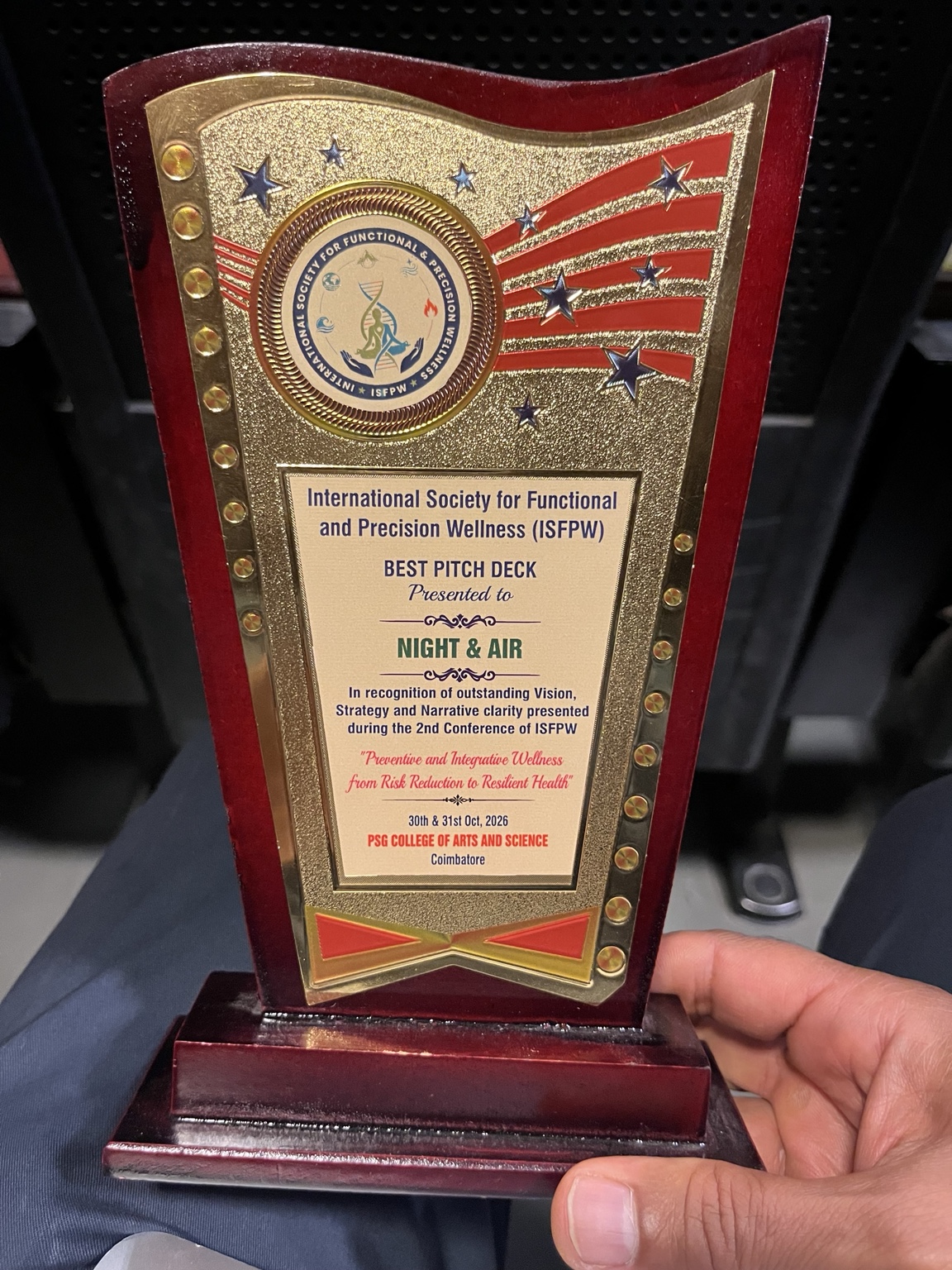
Night & Air received the Best Pitch Deck award at the second conference of the International Society for Functional & Precision Wellness (ISFPW), held on – at PSG College of Arts and Science in Coimbatore, Tamil Nadu. The plaque names Night & Air and recognises the pitch’s vision, strategy and narrative clarity.
The award marks a milestone for a product built around a practical question: after trying something for your snoring, how do you decide whether it is worth keeping?
The organiser’s invitation, received on 26 October, selected founder Sree Kumar for a 15-minute pitch including Q&A on 31 October. This article was first published ahead of the presentation and has now been updated with the award.
The question behind the pitch
Sree has described his own journey as throwing everything at his snoring to see what would stick. There was plenty of advice. The harder part was keeping track of what he had tried, what seemed useful and what remained uncertain.
That experience shaped the app. Night & Air connects observations from a night with a manageable question about a habit. It gives an attempt a reference point, a record and a moment to review the result.
Showing the night behind the number
The pitch brings together the night timeline, selected audio clips with waveforms, Snore Score and morning context. These are concrete observations someone can revisit alongside their memory of the night.
The guided comparison builds on that tracking. A person records their usual routine, builds a baseline from seven qualifying, reviewed nights and then tests one manageable change. Useful habits remain visible while another change is tested.
A comparison can show improvement, no clear change, or a need for more nights. Uncertainty belongs in the result. A short personal comparison cannot account for every influence on sleep or prove that a habit caused a change.
A clearer follow-up conversation
The pitch also describes patient-controlled sharing with a practice. Selected summaries and detailed night graphs can help organise a discussion about recorded nights, morning observations, tests and kept habits.
Audio analysis runs on the phone. Recordings and clips are not uploaded to Night & Air’s servers. Patients can stop clinic sharing; the shared observations support a conversation rather than establish a diagnosis or treatment effect.
The next step is learning from use
The next step outlined in the pitch is a proposed six-week pilot, shaped with three practices and around 20 consenting adults. This is a proposal for discussion, not a completed study or an announcement of confirmed practice partnerships.
The practical questions include whether people can follow the comparison process, understand an uncertain result and bring clearer observations to follow-up. Independent evaluation of the detector is separate work. Our accuracy guide explains what to look for in a validation claim.
The Best Pitch Deck award recognises the presentation’s vision, strategy and narrative. It does not establish clinical effectiveness or endorse the app as a medical device. The presentation’s example scores and patient screens use illustrative data, not reported patient outcomes.
Explore the reasoning behind the product in measurement and personal experiments, or read Sree’s founder story.
Product references and editorial context
- Award photograph supplied by the founder — The plaque names Night & Air as the Best Pitch Deck recipient and records the conference, dates, venue and recognition wording.
- ISFPW conference announcement — Public event dates and venue. The organiser’s selection email, dated 26 October 2026 and retained by Night & Air, confirms the founder’s individual invitation and 15-minute allocation.
- How Night & Air works — Recording, baseline and guided comparison workflow.
- Night & Air for clinicians — Sharing and follow-up context, with the product’s boundaries.

First published on 30 October 2026 from the selection email, conference programme and prepared presentation; updated on 31 October 2026 to record the Best Pitch Deck award shown in the founder-supplied photograph.